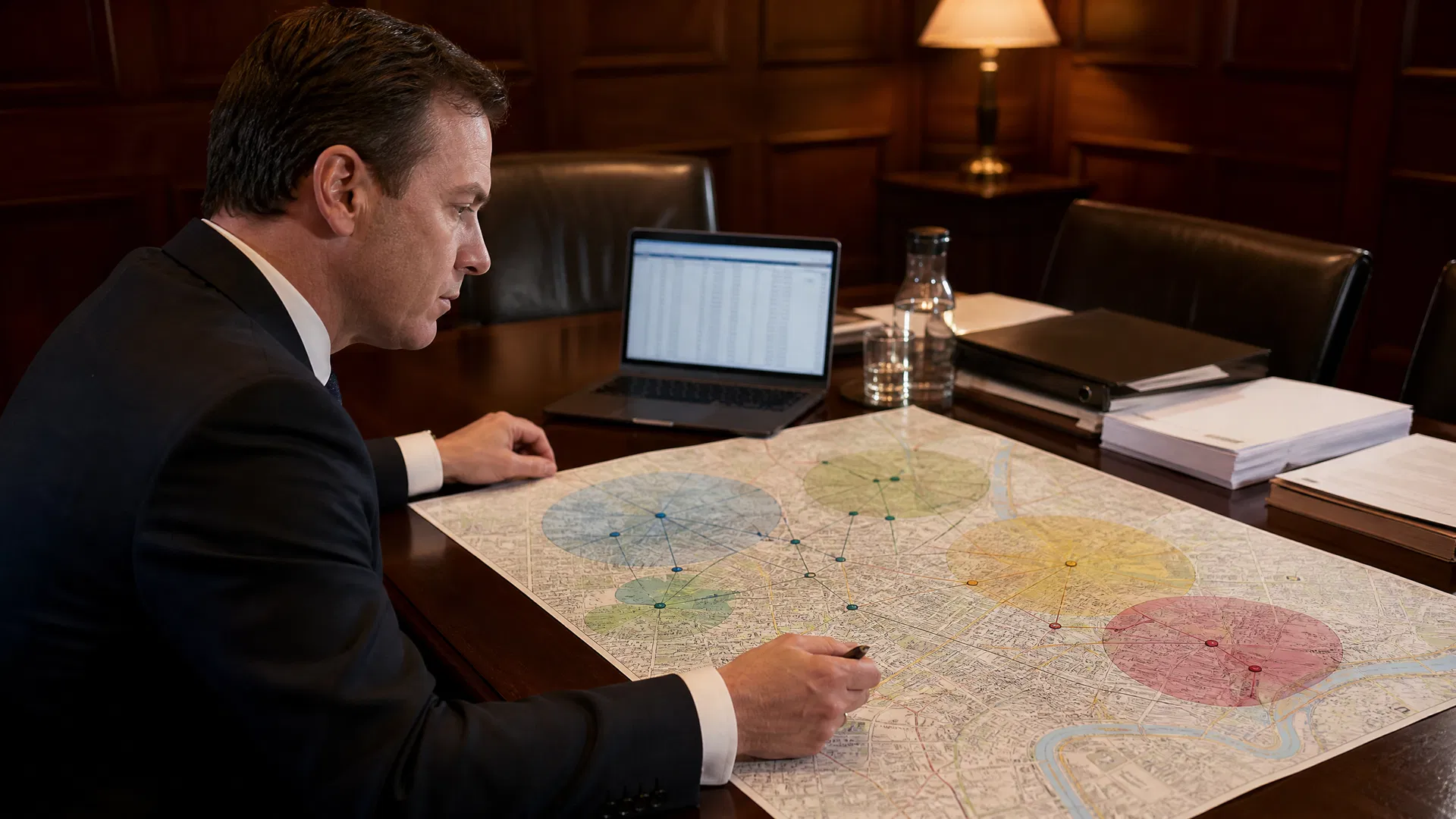
What Is Cell Site Analysis?
Cell site analysis (CSA) is a forensic discipline that uses mobile phone network data — specifically call data records (CDRs) showing which cell towers a phone connected to, and when — to draw inferences about the approximate geographic location of a mobile device at a given time. It does not pinpoint an exact location; it identifies a coverage area.
In criminal proceedings, CSA evidence is used by the prosecution to place a defendant at or near a particular location at a relevant time. Defence solicitors instruct independent cell site experts to scrutinise the prosecution's coverage maps, challenge the accuracy of the network operator's data, and — critically — to address the attribution problem: the fact that locating a phone does not prove who was holding it.
The data is obtained from mobile network operators under the Investigatory Powers Act 2016 or a court order. The expert analyses the CDRs alongside the network operator's cell site data — tower locations, sector orientations, and coverage parameters — to produce a location inference expressed as a range of possible positions, not a single point. The Court of Appeal confirmed this fundamental limitation in R v Plunkett [2013] EWCA Crim 261.
Quick Answers
How Call Data Records Work
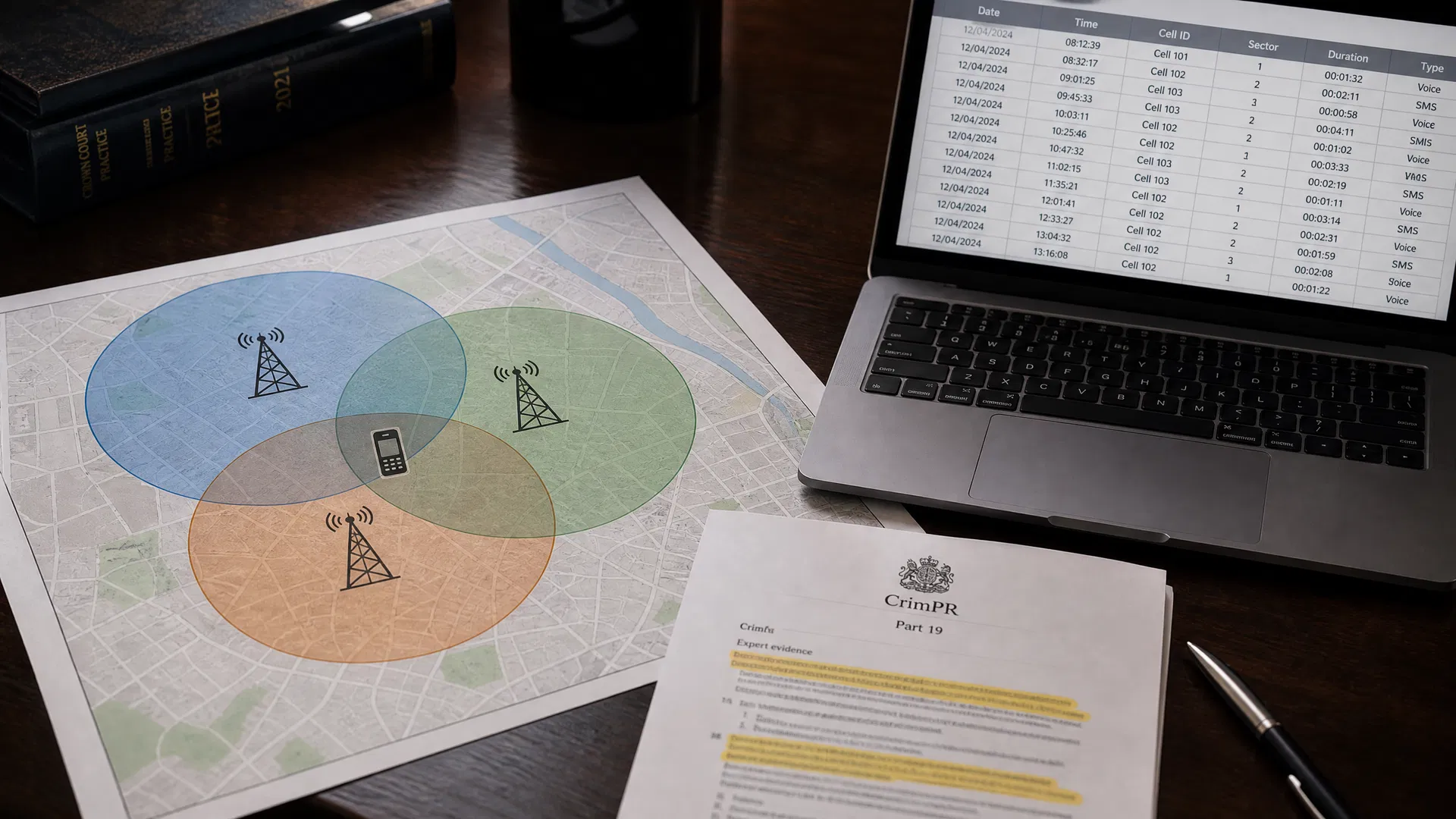
Every time a mobile phone makes or receives a call, sends a text message, or uses mobile data, the network operator logs a call data record. CDRs record the date, time, duration, and — crucially — the cell tower and sector that handled the communication. More recent CDR data may also include timing advance (TA) values, which can be used to estimate the distance between the phone and the tower.
Coverage Versus Location: The Core Limitation
Key principle from R v Plunkett [2013]: Cell site analysis identifies a coverage area — not a precise location. A jury direction that implies CSA evidence places a defendant at a specific address is a misdirection.
The coverage area of a cell tower varies significantly depending on the environment. In dense urban areas, a single cell may cover only a few hundred metres due to signal obstruction by buildings. In rural areas, the same cell may cover several kilometres. A qualified expert maps the coverage area of the relevant cells and expresses the location evidence as a range of possible positions — typically shown as a shaded area on a map — rather than a single point.
The prosecution's coverage maps are typically derived from the network operator's theoretical propagation models. These models do not account for real-world signal variation caused by terrain, buildings, atmospheric conditions, or network congestion. An RF survey — a site visit by the defence expert to measure actual signal coverage — can provide empirical data that significantly differs from the prosecution's theoretical maps, and may substantially widen the range of possible locations.
The Attribution Problem: Phone ≠ Person
Cell site analysis can locate a mobile device. It cannot prove who was holding or using that device at the relevant time. This is the attribution problem — and it is the most frequently overlooked limitation of CSA evidence in criminal proceedings.
R v Bater-James [2020] EWCA Crim 790: The Court of Appeal held that juries must be directed to consider whether the phone was with the defendant at the relevant time — not merely that the phone was in a particular area. A direction that treats the phone's location as equivalent to the defendant's location is a misdirection.
The defence can challenge attribution with evidence that the phone was lent to another person, left in a vehicle, stored at a premises, or used by a family member. The prosecution's assumption that the registered user was in possession of the phone at all relevant times is a factual inference — not a forensic conclusion — and should be scrutinised in every case where location data is central to the prosecution case.
Six Grounds for Challenging Cell Site Evidence
A qualified defence cell site expert can address any or all of these grounds depending on the specific facts of the case.
The network operator's cell site data — tower locations, sector orientations, an…
The coverage area attributed to a particular cell or sector is derived from theo…
Cell site analysis locates a device, not a person. The prosecution's assumption …
Mobile phones do not always connect to the nearest tower. Network congestion, si…
The prosecution expert's methodology, qualifications, and compliance with CrimPR…
Where timing advance (TA) data is used to narrow the estimated distance from a c…
Key Case Law
The Court of Appeal confirmed that cell site analysis does not pinpoint an exact location — it identifies a coverage area. Juries must be directed accordingly.
Foundational authority on the limitations of CSA evidenceThe Court of Appeal confirmed that expert evidence is admissible if it is likely to be outside the jury's knowledge and experience, even if the underlying science is not fully established.
Admissibility of novel forensic evidenceThe Court of Appeal emphasised that juries must be directed to consider whether the phone was with the defendant, not merely that the phone was in a particular area.
Attribution — phone ≠ person direction to juryExpert witnesses in criminal proceedings must comply with CrimPR Rule 19. The court has power to exclude expert evidence that does not meet the required standards.
CrimPR Rule 19 compliance and exclusionWhat We See in Practice: Coverage Map Discrepancies
In cases involving contested cell site evidence, one of the most common issues we encounter is a significant discrepancy between the network operator's theoretical coverage maps and the actual signal coverage measured by an RF survey. Theoretical propagation models are generated by software and do not account for the specific physical environment — a multi-storey car park, a railway cutting, or a dense urban block can all cause a phone to connect to a more distant tower than the model predicts.
We have instructed cell site experts who, following an RF survey, have demonstrated that the prosecution's coverage map overstated the coverage area of a particular cell by a factor of three — meaning the defendant's possible location range was three times larger than the prosecution had represented to the jury. In cases where the prosecution's location evidence is the primary evidence of presence at a scene, this type of finding can be determinative. Early instruction of a defence cell site expert — before the trial timetable is fixed — allows time for an RF survey to be commissioned and its results incorporated into the expert's report.
How to Instruct a Cell Site Analysis Expert
Apply for disclosure of the prosecution's call data records, cell site data, coverage maps, and the prosecution expert's full report. Review the CDRs to identify the specific time periods and locations that are in dispute.
Determine the precise questions the defence expert needs to answer: coverage area accuracy, attribution, cell tower switching, timing advance data, or the need for an RF survey. A focused instruction produces a more effective report and reduces costs.
Instruct a telecommunications expert with specific experience in mobile network architecture and forensic CDR analysis. Confirm they are familiar with CrimPR Rule 19 and have Crown Court experience. Expert Witness UK can provide a vetted shortlist within 24 hours.
Provide the expert with the prosecution's CSA report, all CDRs, cell site data, and coverage maps, together with a clear letter of instruction identifying the issues and the relevant time periods. Include the case summary and any relevant witness statements.
If the prosecution's coverage maps are central to the location evidence and their accuracy is in dispute, commission an RF survey of the relevant cell towers. The expert will advise whether a site visit is necessary based on their initial review of the prosecution's evidence.
Related Concepts
Key terms and concepts in cell site analysis evidence.
Records produced by mobile network operators logging the date, time, duration, cell tower, and sector used for each call, text, and data session.
A site visit by a telecommunications expert to measure the actual radio frequency coverage of specific cell towers at locations relevant to the case.
A directional division of a cell tower's coverage area, typically divided into three 120-degree sectors, providing a broad directional bearing for the connected device.
A technical parameter in GSM networks that measures the signal travel time between a phone and a cell tower, used to estimate the distance from the tower.
The fundamental limitation that CSA can locate a device but cannot prove who was holding or using it at the relevant time.
A court order requiring a mobile network operator to produce call data records and cell site data for use in criminal proceedings.
A map produced by a network operator or expert showing the theoretical coverage area of a cell tower or sector, used to infer the possible location of a device.
The Criminal Procedure Rules governing expert evidence in criminal proceedings, requiring experts to comply with specific duties of disclosure and impartiality.