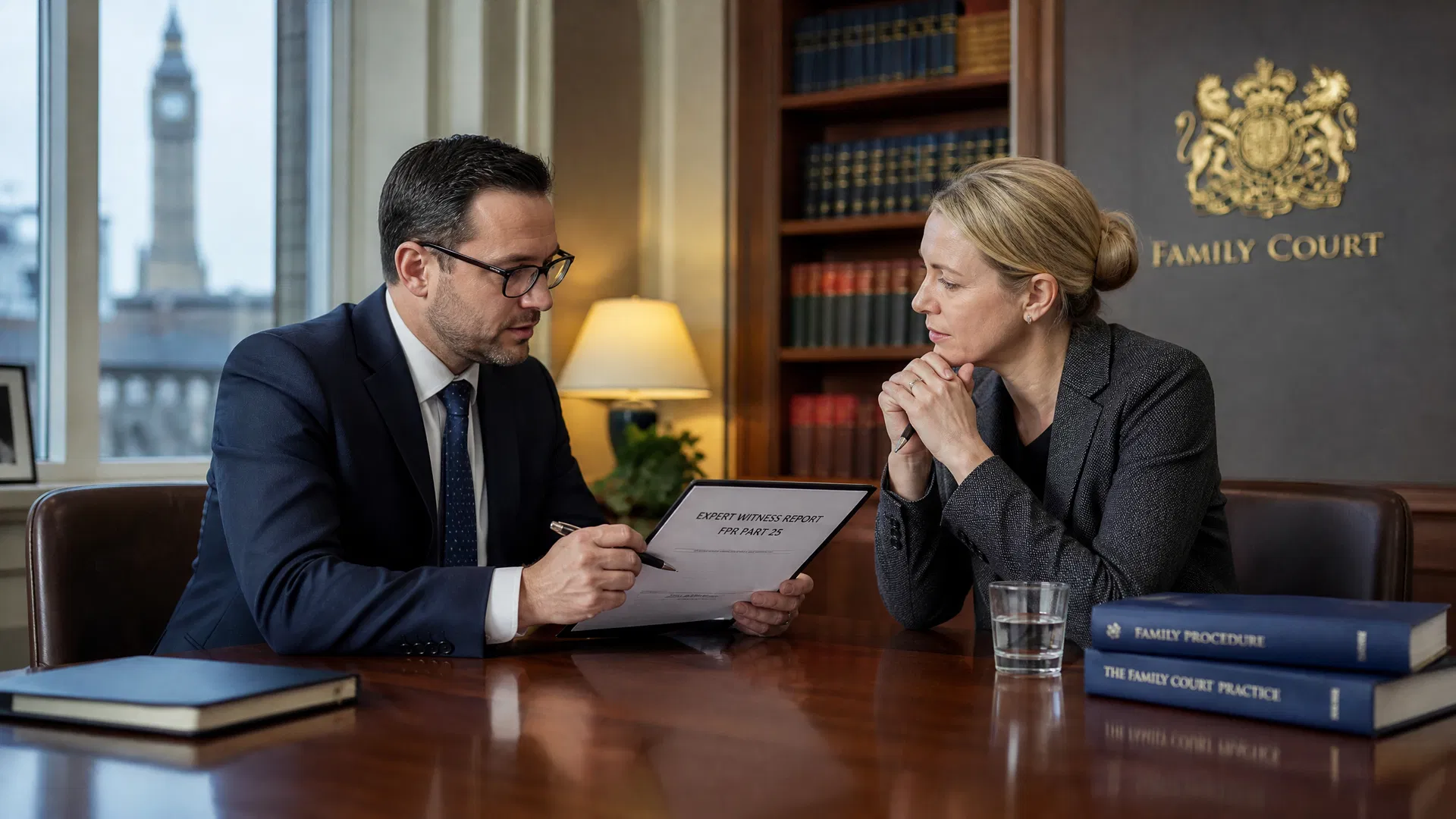
What Is FPR Part 25?
FPR Part 25 is Part 25 of the Family Procedure Rules 2010 (SI 2010/2955) — the primary legal framework governing the use of expert evidence in family proceedings in England and Wales. It applies in the Family Court and the High Court (Family Division) in all proceedings concerning children, financial remedies, and other family matters. Practice Direction 25B supplements Part 25 with detailed requirements for the content of expert reports and letters of instruction.
The most significant feature of Part 25 — and the feature that most distinguishes it from CrimPR Rule 19 and CPR Part 35 — is the requirement for court permission before any expert can be instructed. Under Rule 25.4, no party may instruct an expert without the court's permission, and the court will grant permission only where expert evidence is necessary to assist the court to resolve the proceedings. This necessity test, introduced by s.13(6) of the Children and Families Act 2014, is a higher threshold than the 'reasonably required' standard in civil proceedings.
For family law solicitors, understanding Part 25 is not optional. A report obtained without court permission is inadmissible. A report that does not comply with Practice Direction 25B may be challenged and excluded. Getting the procedural framework right from the outset protects the client, protects the case, and protects the expert.
What FPR Part 25 Requires in Practice
Part 25 creates a comprehensive procedural code for expert evidence in family proceedings. It governs not only when expert evidence may be used, but also how it must be obtained, what it must contain, and how it must be served. The Rules are supplemented by Practice Direction 25B, which sets out 12 mandatory elements for every expert report, and Practice Direction 25E, which governs experts' discussions and joint statements.
Unlike criminal proceedings under CrimPR Rule 19, where the parties may instruct their own experts without prior court permission, family proceedings require court permission at every stage. This reflects the court's duty to manage proceedings in the best interests of the child and to ensure that expert evidence is genuinely necessary rather than merely convenient or tactical.
The Six Key Rules in Part 25
Part 25 contains six rules. Each rule addresses a distinct aspect of the expert evidence framework in family proceedings. Click each rule to expand the full explanation.
Practice Direction 25B — 12 Mandatory Report Contents
Practice Direction 25B supplements FPR Part 25 with 12 mandatory requirements for the content of every expert report in family proceedings. A report that omits any of these elements may be challenged as non-compliant and the court may refuse to admit it. Expert Witness UK carries out a compliance review of all reports before delivery.
Name and Qualifications
The expert's full name, professional qualifications, and the institution that awarded them. Where the expert holds a specialist register status (such as GMC Specialist Register or HCPC Register), this must be stated.
Professional Registration
The expert's current professional registration details, including the name of the regulatory body, the registration number, and any conditions or restrictions on registration.
Substance of Instructions
A statement of the substance of all instructions received from all parties, whether written or oral. This ensures transparency and allows the court to assess whether the expert has been given a balanced and accurate account of the facts.
Facts and Assumptions
The facts and assumptions on which the opinion is based. Where the expert has been given competing versions of events, the report must address each version and state the opinion on each.
Expert's Opinion
The expert's opinion on each question asked in the letter of instruction. The opinion must be expressed clearly and must distinguish between matters within the expert's area of expertise and matters outside it.
Range of Opinion
Where there is a range of opinion on a question, a summary of that range and the reasons for the expert's own view. The expert must not simply assert their own view without acknowledging that other views exist.
Literature and Materials
A statement of the literature or other material relied upon in forming the opinion. This allows the court and the parties to assess the evidential basis for the opinion and to identify any gaps or limitations.
Limitations on Opinion
Any limitations on the expert's opinion, including limitations arising from the information available, the methodology used, or the expert's own area of expertise. An expert must not overstate the certainty of their opinion.
Summary of Conclusions
A clear summary of the conclusions reached. The summary must be consistent with the body of the report and must not introduce new material or opinions not addressed in the body.
Overriding Duty Statement
A statement that the expert understands their overriding duty to the court under FPR Rule 25.3, that they have complied with that duty, and that the report has been prepared in accordance with FPR Part 25 and Practice Direction 25B.
Awareness of Requirements
A statement that the expert is aware of the requirements of FPR Part 25 and Practice Direction 25B. Without this statement, the report may be challenged as non-compliant.
Signature and Date
The expert's signature and the date on which the report was completed. Where the report has been amended or supplemented, each version must be separately signed and dated.
The Necessity Test — When Will the Court Grant Permission?
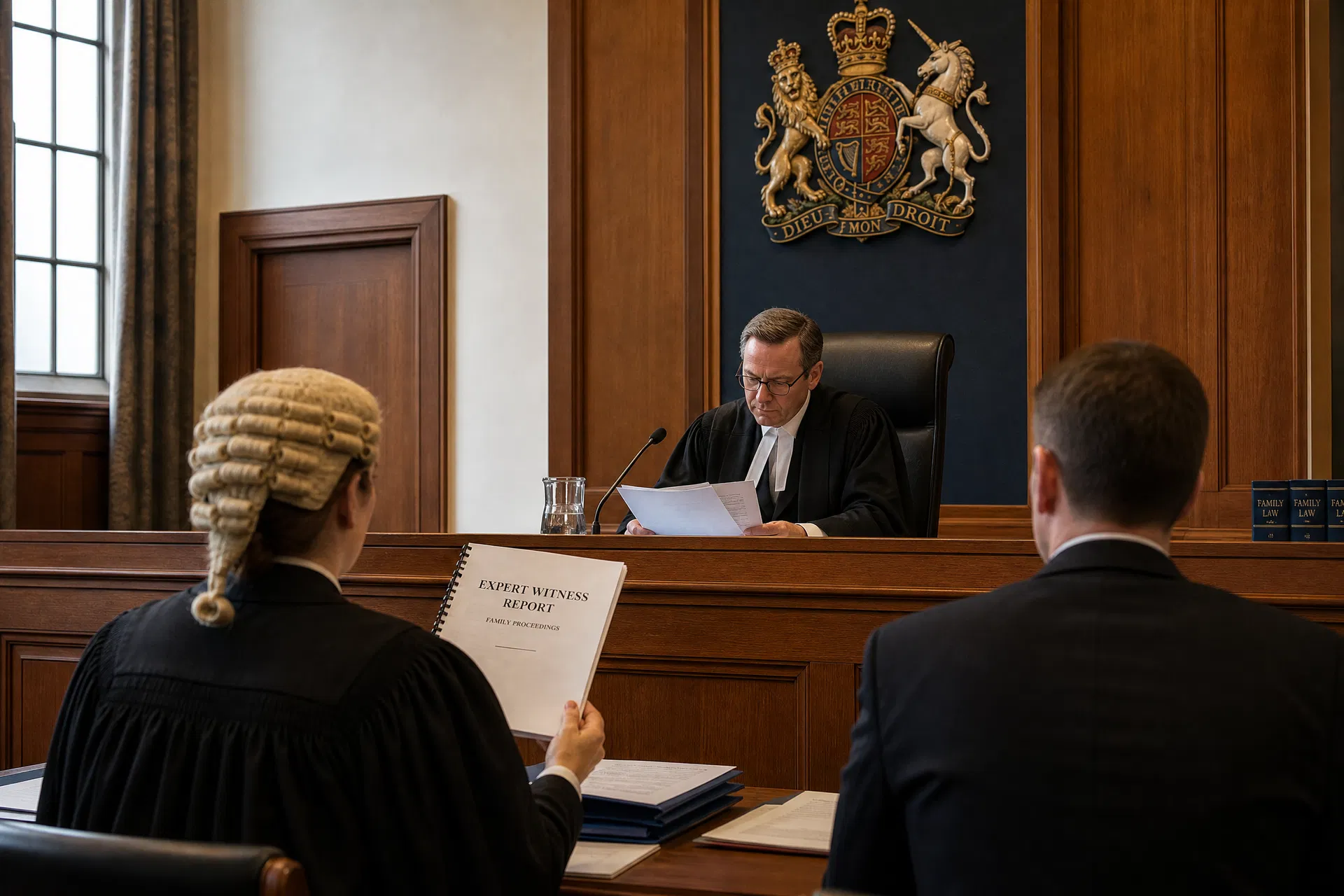
Section 13(6) of the Children and Families Act 2014 provides that in children proceedings, the court may give permission for expert evidence only if it is necessary to assist the court to resolve the proceedings. The word 'necessary' is deliberately stronger than 'desirable' or 'helpful'. The court in Re H-L (Expert Evidence: Behavioural Genetics) [2021] EWCA Civ 1913 confirmed that the necessity test requires the court to ask whether the proceedings can be resolved without the expert evidence — if they can, permission will be refused.
In practice, the court will grant permission where the issue is genuinely complex and outside the knowledge of a lay tribunal. Parenting capacity assessments, psychiatric assessments for fitness to care, psychological assessments in cases involving domestic abuse or coercive control, and hair strand drug and alcohol testing are all types of expert evidence that routinely satisfy the necessity test.
Practical Tip: Apply for Permission Early
The application for permission should be made at the first hearing or case management conference. A late application risks disrupting the timetable and may be refused on that ground alone, even where the expert evidence is otherwise necessary. Expert Witness UK can provide a CV and fee estimate for the court's consideration at the permission hearing.
Single Joint Experts in Family Proceedings
In family proceedings, the court frequently directs that a single joint expert (SJE) be instructed rather than allowing each party to instruct their own expert. This is a significant departure from the practice in criminal proceedings, where parties routinely instruct separate experts. The SJE regime in family proceedings reflects the court's duty to manage proceedings proportionately and to avoid the cost and delay of competing expert evidence.
Where the court directs a single joint expert, the parties must agree the letter of instruction or, failing agreement, the court will settle it. Both parties receive the report simultaneously. The SJE's duty is to the court, not to either instructing party. Either party may put written questions to the SJE under Rule 25.6, but the questions must be for the purpose of clarification only.
Single Joint Expert
- Instructed by both parties jointly
- Letter of instruction agreed by parties
- Report served on both parties simultaneously
- Duty to the court only
- Lower cost — one fee shared
- Frequently directed in family proceedings
Separate Party Experts
- Each party instructs their own expert
- Separate letters of instruction
- Reports served on instructing party first
- Duty to court but instructed by one party
- Higher cost — two fees
- Permitted where court grants permission
The 26-Week Timetable and Expert Evidence
Under s.32 of the Children Act 1989 (as amended by the Children and Families Act 2014), care and supervision proceedings must be completed within 26 weeks of the application being issued. This statutory timetable has a direct impact on the instruction of expert witnesses in care proceedings. The court will only grant permission for expert evidence where the instruction can be accommodated within the 26-week timetable.
In practice, the expert's report is typically required within 6 to 8 weeks of instruction. This means that the expert must be available to accept instructions, carry out the assessment, and produce a compliant report within a tight timeframe. Expert Witness UK confirms timetable availability before instruction to ensure the 26-week deadline is met.
Typical Expert Evidence Timeline in Care Proceedings
How to Instruct an Expert Under FPR Part 25 — Five Steps
The following five-step process covers the key procedural requirements for instructing an expert witness in family proceedings in compliance with FPR Part 25 and Practice Direction 25B.
Apply for Court Permission at the First Hearing
Raise the need for expert evidence at the first hearing or case management conference. The application must identify the expert's discipline, the specific questions to be addressed, the estimated cost, and the proposed timetable. The court will apply the necessity test under s.13(6) of the Children and Families Act 2014. Expert Witness UK can provide a CV and fee estimate for the court's consideration at the permission hearing.
Agree the Letter of Instruction with All Parties
In family proceedings, the letter of instruction must be agreed between all parties before it is sent to the expert. It must set out the background facts, the specific questions, the relevant documents, and the court's timetable. Practice Direction 25B contains a template letter of instruction. Expert Witness UK can assist with drafting the letter of instruction to ensure it complies with PD 25B.
Instruct a Suitably Qualified and Registered Expert
The expert must hold the qualifications, specialist register status, and professional body membership appropriate to the issue. For psychological assessments, the expert must be HCPC registered and hold BPS Chartered status. For psychiatric assessments, the expert must be GMC registered and hold MRCPsych or FRCPsych. Expert Witness UK vets all panel experts for FPR Part 25 compliance before instruction.
Review the Report for Practice Direction 25B Compliance
Before filing the report with the court, check that it contains all 12 mandatory elements under Practice Direction 25B, including the overriding duty statement, the literature relied upon, and any limitations on the opinion. A non-compliant report may be rejected by the court. Expert Witness UK carries out a compliance review of all reports before delivery.
Manage Supplementary Questions Within the Timetable
Supplementary questions to the expert must be proportionate, must be agreed between the parties where possible, and must be submitted within the court's timetable. Disproportionate or repetitive questions may be disallowed by the court and a costs order made against the party submitting them.
FPR Part 25 vs CrimPR Rule 19 vs CPR Part 35
The three procedural codes governing expert evidence in England and Wales differ significantly in their requirements. Understanding these differences is essential for solicitors who practise across multiple jurisdictions.
| Aspect | Criminal (CrimPR 19) | Family (FPR 25) | Civil (CPR 35) |
|---|---|---|---|
| Governing Rules | CrimPR Rule 19 | FPR Part 25 + PD 25B | CPR Part 35 + PD 35 |
| Court Permission | Not required as of right | Always required (necessity test) | Required in some courts |
| Legal Test | Relevant and admissible | Necessary (s.13(6) CFA 2014) | Reasonably required |
| Single Joint Expert | Rare — parties usually instruct separately | Common — court frequently directs SJE | Common in fast track |
| Timetable | Court timetable (no statutory limit) | 26-week limit (care proceedings) | Court timetable |
| Overriding Duty | Rule 19.2 — duty to the court | Rule 25.3 — duty to the court | Part 35.3 — duty to the court |
| Report Declaration | Rule 19.4(i) declaration required | PD 25B declaration required | Part 35.10 declaration required |
| Joint Statements | Rule 19.6 — directed by court | PD 25E — directed by court | Part 35.12 — directed by court |
LAA Funding for Expert Evidence in Family Proceedings
Expert evidence in legally aided family proceedings is funded by the Legal Aid Agency (LAA). The solicitor must obtain prior authority from the LAA before incurring the cost of the expert's report, unless the cost falls within the delegated functions limit. The prior authority application must identify the expert, the estimated cost, and the specific questions to be addressed.
Where the expert's fee exceeds the LAA's standard rates, the solicitor must apply for prior authority at an enhanced rate. The LAA will consider whether the enhanced rate is justified by the complexity of the case and the expert's qualifications. Expert Witness UK provides fee quotes that are structured to support prior authority applications, including a breakdown of the assessment time, report preparation time, and any court attendance fee.
Frequently Asked Questions
Common questions from family law solicitors about FPR Part 25 and the instruction of expert witnesses in family proceedings.
Related Subtopics
Key concepts and related procedural frameworks that intersect with FPR Part 25 in family proceedings.
Necessity Test
The legal threshold under s.13(6) of the Children and Families Act 2014 by which the court determines whether expert evidence is required — higher than the CPR 'reasonably required' standard.
Practice Direction 25B
The supplementary practice direction to FPR Part 25 that sets out 12 mandatory elements for every expert report in family proceedings, including the overriding duty statement and literature relied upon.
Single Joint Expert (SJE)
An expert instructed jointly by two or more parties in family proceedings, frequently directed by the court to reduce cost and delay and to avoid adversarial expert battles.
26-Week Timetable
The statutory timetable under s.32 of the Children Act 1989 (as amended) requiring care and supervision proceedings to be completed within 26 weeks of issue.
Letter of Instruction
The document sent to the expert setting out the background facts, the specific questions to be addressed, and the relevant documents — which must be agreed between all parties in family proceedings.
Prior Authority (LAA)
The Legal Aid Agency approval required before incurring the cost of expert evidence in legally aided family proceedings, including an enhanced rate application where the expert's fee exceeds standard LAA rates.
Parenting Capacity Assessment
A psychological or psychiatric assessment of a parent's ability to meet a child's needs, one of the most commonly instructed types of expert evidence in public law children proceedings.
Experts' Discussion (PD 25E)
A directed meeting between experts instructed by different parties to identify areas of agreement and disagreement, governed by Practice Direction 25E and resulting in a joint statement.
Related Guides
Family Law Expert Witnesses
Parenting Capacity Assessments
Hair Strand Testing in Family Court
Role of Expert Witness in Family Court
Domestic Abuse & Coercive Control Assessments
Non-Accidental Injury Expert Evidence
Need a FPR Part 25 Compliant Expert?
Expert Witness UK provides psychologists, psychiatrists, and other specialists for family proceedings. All experts are vetted for FPR Part 25 compliance and timetable availability is confirmed before instruction.
References & Primary Sources
Primary legislation, key case law, and professional guidance underpinning expert evidence in family proceedings under FPR Part 25.
- Family Procedure Rules 2010 Part 25 ↗SI 2010/2955 — Expert Evidence
- Practice Direction 25B ↗The Duties of an Expert and the Content of Expert Reports
- Children and Families Act 2014, s.13(6) ↗Necessity test for expert evidence in children proceedings
- Children Act 1989, s.32 ↗26-week timetable for care proceedings
- Re C (A Child) [2015] EWCA Civ 1093 ↗Leading case on necessity of expert evidence in care proceedings
- Re H-L (Expert Evidence: Behavioural Genetics) [2021] EWCA Civ 1913 ↗Confirmation of the necessity test threshold
- Re S (A Child) [2015] EWCA Civ 689 ↗Expert evidence and the 26-week timetable
- Re TG (Care Proceedings: Case Management) [2013] EWCA Civ 5 ↗Case management and expert evidence in care proceedings
- Family Justice Council — Guidance on Expert Witnesses ↗Guidance on the Use of Expert Witnesses in Family Proceedings (2021)
- CAFCASS: Experts in Family Proceedings ↗Guidance for family court advisers on instructing experts
- The Law Society Practice Note — Experts in Family Proceedings ↗Practical guidance for solicitors instructing experts
- Association of Lawyers for Children — Position Statement on Expert Evidence ↗ALC guidance on the use and instruction of expert witnesses
Content reflects the law as at 2026. Always verify currency at legislation.gov.uk and judiciary.gov.uk.
Related Guides
Role of Expert Witness in Family Court
How the court uses expert evidence in care, contact, and adoption proceedings.
Parenting Capacity Assessment
DoH Framework domains, capacity to change evidence, and FPR Part 25 compliance.
Letter of Instruction to an Expert Witness
A 10-element annotated template and common drafting errors to avoid.
Joint Expert Statements & Experts' Meetings
The procedure for experts' meetings, joint statements, and areas of agreement.
Legal Aid & Private Funding
Legal Aid and privately funded instructions, prior-authority guidance, and fee-estimate information for family proceedings.
Family Law Expert Witnesses
Our full panel of psychology, psychiatry, and forensic experts for family proceedings.