Hair Strand Testing in Legal Proceedings: A Solicitor's Guide
Hair strand testing provides a retrospective window into drug and alcohol use that urine and blood tests cannot match. This guide explains what the test detects, how results are interpreted under SoHT 2022 guidelines, and the key issues that arise in care proceedings, private law, criminal defence, and immigration cases.

What Is Hair Strand Testing?
Hair strand testing — also called hair follicle testing or hair drug testing — is a forensic toxicology technique that detects drugs and alcohol biomarkers incorporated into the hair shaft over time. Unlike urine or blood testing, which provides a snapshot of recent use, hair strand testing provides a retrospective window of weeks to months, making it the preferred method for assessing patterns of chronic substance use in legal proceedings. The current reference standard for courts in England and Wales is the Society of Hair Testing (SoHT) 2022 Consensus Document.
The scientific basis of the test is straightforward. As hair grows, substances circulating in the bloodstream — and their metabolites — are incorporated into the hair shaft through the hair follicle. Because hair grows at approximately 1 centimetre per month, a segmented analysis of a hair sample can reveal not only whether a substance was used but when, and at what approximate frequency.
Any laboratory instructed in legal proceedings should be accredited to ISO 17025 for the specific analytes being tested and working to SoHT 2022 guidelines. Results from non-accredited laboratories, or from laboratories using non-validated methods, carry reduced evidential weight and are vulnerable to challenge.
Common Questions
SoHT 2022 Cut-Off Thresholds
The following table sets out the SoHT 2022 consensus cut-off thresholds for the most commonly tested substances in legal proceedings. A result at or above the cut-off is reported as positive. Results below the cut-off are reported as negative, even if the substance is detected at a lower level. These thresholds are set to minimise false positives from passive exposure and prescribed medication.
| Substance | SoHT Cut-Off | Detection Window | Notes |
|---|---|---|---|
| Cocaine / Benzoylecgonine | 0.5 ng/mg | 3–9 months | Benzoylecgonine is the primary metabolite; cocaine itself may also be detected |
| Cannabis (THC) | 0.1 pg/mg | 3–9 months | THC incorporates into hair via sebum; passive exposure rarely produces positive results above cut-off |
| Heroin (6-MAM) | 0.2 ng/mg | 3–9 months | 6-monoacetylmorphine is specific to heroin use; morphine alone may indicate codeine use |
| Amphetamines / MDMA | 0.2 ng/mg | 3–9 months | Includes amphetamine, methamphetamine, MDA, and MDMA |
| Benzodiazepines | Variable | 3–9 months | Cut-offs vary by compound; prescribed use must be considered in interpretation |
| Alcohol — EtG | 30 pg/mg | 3 months per cm | Above 30 pg/mg indicates excessive consumption (>60g/day); cosmetic treatment can reduce levels |
| Alcohol — FAEE | 0.5 ng/mg | 3 months per cm | Supplementary marker; used alongside EtG; less affected by cosmetic treatment |
Source: Society of Hair Testing (SoHT) Consensus 2022 (DOI: 10.1002/dta.3526). Cut-offs are for segmented hair analysis. Consult the full SoHT document for complete guidance.
Alcohol Markers: EtG and FAEE Explained
Alcohol itself does not incorporate into hair. Instead, two indirect biomarkers are used: ethyl glucuronide (EtG) and fatty acid ethyl esters (FAEE). Understanding the difference between these markers — and their respective limitations — is essential for instructing solicitors when reviewing test results and advising clients.
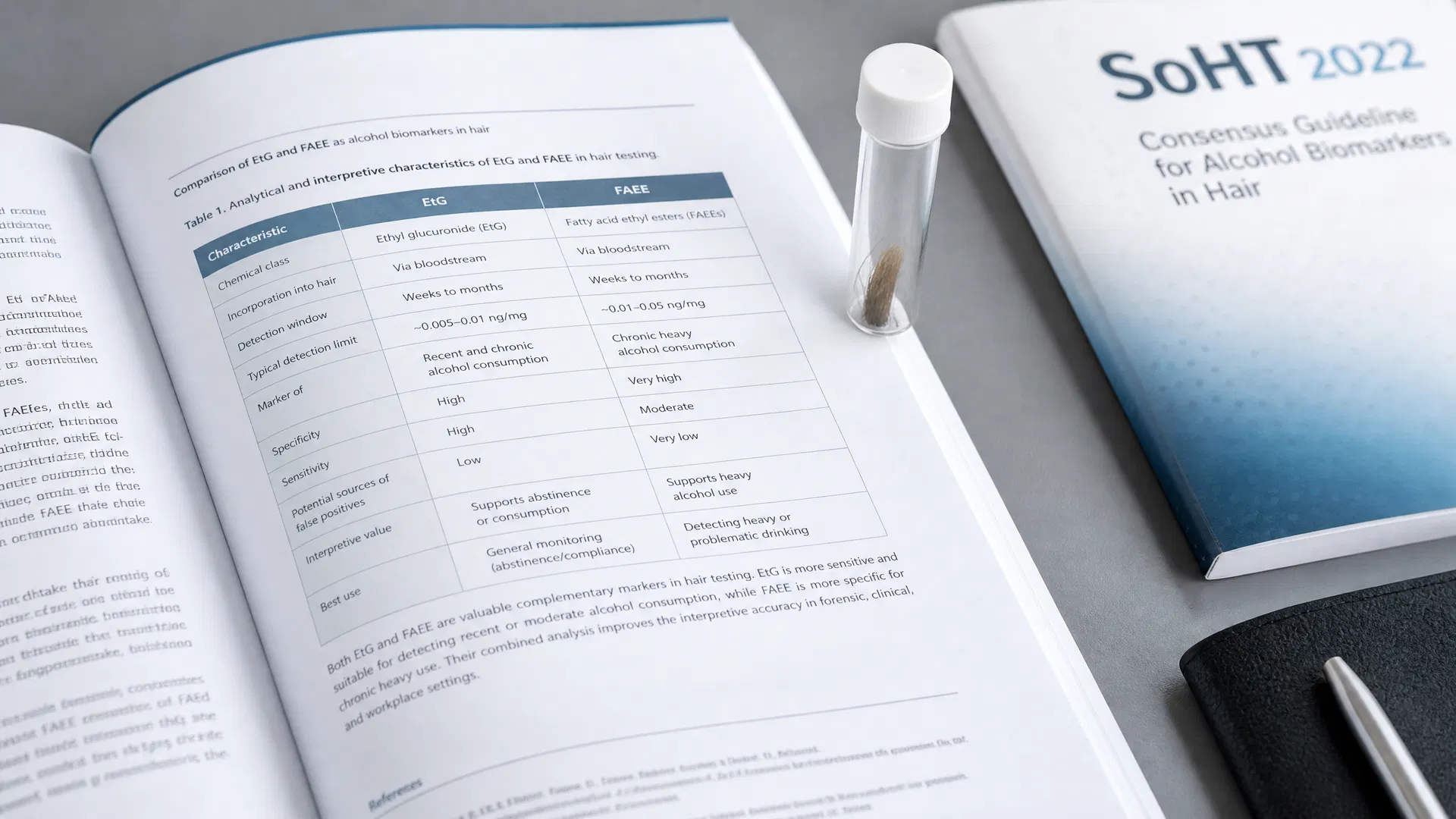
EtG (Ethyl Glucuronide)
- Direct metabolite of alcohol
- Incorporates into hair via sweat and sebum
- SoHT cut-off: 30 pg/mg (excessive use) and 7 pg/mg (any use)
- Above 30 pg/mg indicates consumption exceeding 60g alcohol per day
- Cosmetic treatments (bleaching, perming) significantly reduce EtG levels
- Preferred primary marker under SoHT 2022
FAEE (Fatty Acid Ethyl Esters)
- Formed from alcohol and fatty acids
- Incorporates into hair through sebum
- SoHT cut-off: 0.5 ng/mg (sum of four esters)
- Less affected by cosmetic hair treatment than EtG
- Used as supplementary marker alongside EtG
- Can be elevated by external contamination in some settings
Interpreting discordant EtG and FAEE results
Where EtG is negative but FAEE is positive — or vice versa — the discordance requires expert interpretation. A negative EtG in chemically treated hair, combined with a positive FAEE, may still indicate chronic alcohol use. Conversely, a positive EtG with a negative FAEE may indicate moderate rather than excessive use. These nuances are precisely why a qualified toxicologist's report is required, not simply a laboratory result.
Hair Strand Testing in Care Proceedings
In public law children proceedings, hair strand testing is most commonly ordered where there are allegations of chronic alcohol misuse or regular drug use by a parent or carer. The test is typically directed by the court under a case management order under FPR Part 25, and the sample is collected by an independent collector with a documented chain of custody.
The expert's role is not simply to report the laboratory result. The court requires an interpretation of what the result means in the context of the individual's history, the specific questions posed by the court, and the welfare of the child. A positive result for cocaine use, for example, does not automatically establish that a parent poses a risk to their child — the expert must address frequency, quantity, and the likely impact on parenting capacity.
Key issues the expert must address
Whether the result indicates occasional, regular, or chronic use, based on the level detected and the SoHT thresholds
Whether the pattern of use is consistent with the subject's account of their substance use history
Whether any alternative explanation — cosmetic treatment, passive exposure, prescribed medication — is plausible on the facts
The likely impact of the detected level of use on the subject's functioning and parenting capacity
Whether further testing — such as urine testing, blood testing, or a repeat hair strand test — is indicated
Private Law and Criminal Proceedings
Private Law Children Proceedings
- Allegations of substance use affecting contact or residence
- Contested contact applications where drug or alcohol use is in issue
- Applications to vary existing orders where substance use has changed
- Welfare reports where the CAFCASS officer has identified substance use concerns
Criminal Defence
- Drug-driving cases (Section 5A RTA 1988) — personal use vs supply
- Drug supply prosecutions where frequency of personal use is in issue
- Cases where the defendant's drug dependency is relevant to sentencing
- Confiscation proceedings where drug use expenditure is in dispute
Challenging Hair Strand Test Results: Re H and Re D
Re H (Children) [2017] EWCA Civ 1792
The Court of Appeal confirmed that hair strand test results are not conclusive and must be interpreted in context alongside other evidence. A positive result does not automatically establish risk to a child. The court must consider all the evidence in the round, including the parent's account and any alternative explanations for the result.
Re D (Children) [2024]
The court highlighted the limitations of EtG testing in chemically treated hair and the need for expert interpretation of discordant EtG/FAEE results. The judgment emphasised that a negative EtG result in treated hair does not exclude alcohol use, and that the expert must address this limitation expressly in their report.
Hair strand test results are not infallible. There are several legitimate grounds on which results can be challenged, and instructing solicitors should consider these carefully before accepting a positive result at face value.
Cosmetic hair treatment
Bleaching, perming, and chemical straightening can significantly reduce EtG levels. A negative EtG result in heavily treated hair does not exclude alcohol use. Conversely, a positive result in treated hair carries greater weight.
Hair colour and porosity
Dark, coarse hair has higher melanin content and may incorporate some drugs at higher levels than blonde or fine hair. This can affect the interpretation of results near the cut-off threshold.
External contamination
Passive exposure to cannabis smoke can produce low-level positive results in some circumstances. The SoHT cut-off thresholds are set to minimise false positives from passive exposure, but the issue may be relevant in borderline cases.
Chain of custody
The integrity of the sample collection process must be documented. Any break in the chain of custody — from collection to laboratory analysis — undermines the reliability of the result and may be grounds for challenge.
Laboratory accreditation
The laboratory must hold ISO 17025 accreditation for the specific analytes being tested. Results from non-accredited laboratories, or from laboratories using non-validated methods, carry reduced evidential weight.
Prescribed medication
Prescribed opiates, benzodiazepines, and some other medications will produce positive results. The expert must consider and address the possibility of prescribed use before attributing a positive result to illicit drug use.
From Our Work
Discordant EtG/FAEE Results in Treated Hair
A pattern we encounter regularly in care proceedings involves parents who have undergone significant cosmetic hair treatment — bleaching or chemical straightening — in the period between the alleged substance use and the court-directed test. In these cases, EtG levels are frequently reduced below the SoHT 30 pg/mg threshold, while FAEE levels remain elevated above 0.5 ng/mg.
Without expert interpretation, a solicitor reviewing the laboratory result might conclude that the EtG negative result exonerates their client. In fact, the discordant FAEE positive — combined with evidence of cosmetic treatment — may be consistent with chronic alcohol use at a level that EtG can no longer detect. The expert's role in these cases is to explain the science to the court, not simply to report the numbers.
This is why we always instruct forensic toxicologists who will address discordant results expressly in their report, rather than laboratories that produce results without contextual interpretation. The distinction matters in every case where cosmetic treatment is a factor.
How to Instruct a Hair Strand Testing Expert
Step 1: Define the Testing Questions
Identify the specific questions the court needs answered — period of use, frequency, quantity, and substance type. These will determine the segmentation period and the analytes to be tested.
Step 2: Obtain Court Permission
In family proceedings, obtain a court direction under FPR Part 25 before instructing the expert. In criminal proceedings, ensure compliance with CrimPR Rule 19 and obtain prior authority from the LAA if publicly funded.
Step 3: Select an ISO 17025 Accredited Laboratory
Instruct a laboratory accredited to ISO 17025 for the specific analytes being tested and working to SoHT 2022 guidelines. Confirm accreditation scope before instructing.
Step 4: Arrange Sample Collection
Arrange for sample collection by an independent collector with a documented chain of custody. Ensure the collector records hair colour, cosmetic treatment history, and collection site.
Step 5: Commission the Expert Report
Instruct the forensic toxicologist to produce a report addressing the court's questions, interpreting the laboratory results in context, and addressing any limitations or alternative explanations.
Related Subtopics
SoHT 2022 Cut-Off Thresholds
The international consensus cut-off values for drugs and alcohol in hair, published by the Society of Hair Testing. The reference standard for courts in England and Wales.
EtG (Ethyl Glucuronide)
The primary alcohol biomarker in hair strand testing. A direct metabolite of alcohol that incorporates into hair through sweat and sebum. Significantly reduced by cosmetic hair treatment.
FAEE (Fatty Acid Ethyl Esters)
A supplementary alcohol biomarker used alongside EtG. Less affected by cosmetic treatment than EtG, making it useful for interpreting results in treated hair.
ISO 17025 Accreditation
The international standard for testing and calibration laboratory competence. Any laboratory instructed in legal proceedings must hold ISO 17025 accreditation for the specific analytes being tested.
Chain of Custody
The documented process of sample collection, labelling, transport, and storage that establishes the integrity of the sample from collection to analysis. A break in the chain of custody undermines the reliability of the result.
Segmented Hair Analysis
The division of a hair sample into sequential 3 cm segments, each representing approximately 3 months of use. Segmented analysis allows the expert to identify when use occurred and whether it was increasing, decreasing, or consistent.
Cosmetic Hair Treatment Effects
Bleaching, perming, and chemical straightening significantly reduce EtG levels in hair. A negative EtG result in heavily treated hair does not exclude alcohol use and requires careful expert interpretation.
Parenting Capacity Assessment
A broader assessment of a parent's ability to meet their child's needs, of which hair strand testing may form one component. The hair strand test result must be interpreted within the context of the full parenting capacity assessment.
Frequently Asked Questions
Related Guides
Drug & Alcohol Testing Methods Explained
Urine, blood, oral fluid, and breath testing compared
FPR Part 25 — Expert Evidence in Family Proceedings
The necessity test, letter of instruction, and report requirements
Parenting Capacity Assessment
How hair strand testing fits within the broader welfare assessment
Drug & Alcohol Expert Witness Services
Forensic toxicologists and drug and alcohol specialists
Family Law Expert Witnesses
Expert witness services for care and private law proceedings
Forensic Toxicology Expert Witness
Post-mortem toxicology, drug-driving, and analytical methods
Instruct a Hair Strand Testing Expert
Expert Witness UK provides forensic toxicologists and drug and alcohol specialists for hair strand testing interpretation in care, private law, and criminal proceedings.
+44 (0) 330 024 2770Quick Reference
References & Primary Sources
Key legislation, case law, and professional guidance relevant to hair strand testing in UK legal proceedings.
- Children Act 1989 ↗Key legislation governing children's welfare in England and Wales.
- Family Procedure Rules 2010, Part 25 ↗Procedural rules for expert evidence in family court proceedings.
- Road Traffic Act 1988, s.5A ↗Prescribed drug limits for driving; relevant to drug-driving hair strand testing.
- Misuse of Drugs Act 1971 ↗Governs the control of drugs in the UK, relevant to drug testing contexts.
- Re H (Children) [2017] EWCA Civ 1792 ↗Court of Appeal: hair strand test results are not conclusive and must be interpreted in context.
- Re C (Hair Strand Testing) [2019] EWFC 20 ↗Landmark case on the interpretation and use of hair strand testing in family proceedings.
- Re F (Children) [2016] EWCA Civ 546 ↗Discusses the role of expert evidence in assessing parental capacity.
- Re G (Children) [2006] UKHL 43 ↗House of Lords decision on the welfare principle and expert evidence in children cases.
- SoHT 2022 Consensus Document ↗Society of Hair Testing international guidelines for drug and alcohol hair analysis. DOI: 10.1002/dta.3526
- Wurst FM et al. (2015) ↗Ethyl glucuronide in hair — a review of its use as a biomarker of alcohol consumption. DOI: 10.1093/alcalc/agv020
- Pragst F & Balikova MA (2006) ↗State of the art in hair analysis for detection of drug and alcohol abuse. DOI: 10.1016/j.cca.2006.01.023
- Family Justice Council Guidance ↗Guidance for experts in family proceedings, including drug and alcohol testing.
Related Guides
Drug & Alcohol Testing Methods Explained
Urine, blood, hair, and oral fluid testing — what each method detects and its limitations.
Parenting Capacity Assessment
DoH Framework domains, capacity to change evidence, and FPR Part 25 compliance.
Domestic Abuse & Coercive Control Assessments
DASH risk assessment, Evan Stark coercive control framework, and PD12J compliance.
Drug & Alcohol Expert Witnesses
Our panel of forensic toxicologists and drug & alcohol experts for family and criminal proceedings.
FPR Part 25 Explained
The procedural rules governing expert evidence in family proceedings.
Challenging Expert Evidence
Grounds for challenge, CPD 19B, and the procedure for disputing expert opinion.