What Is Drug and Alcohol Testing in Legal Proceedings?
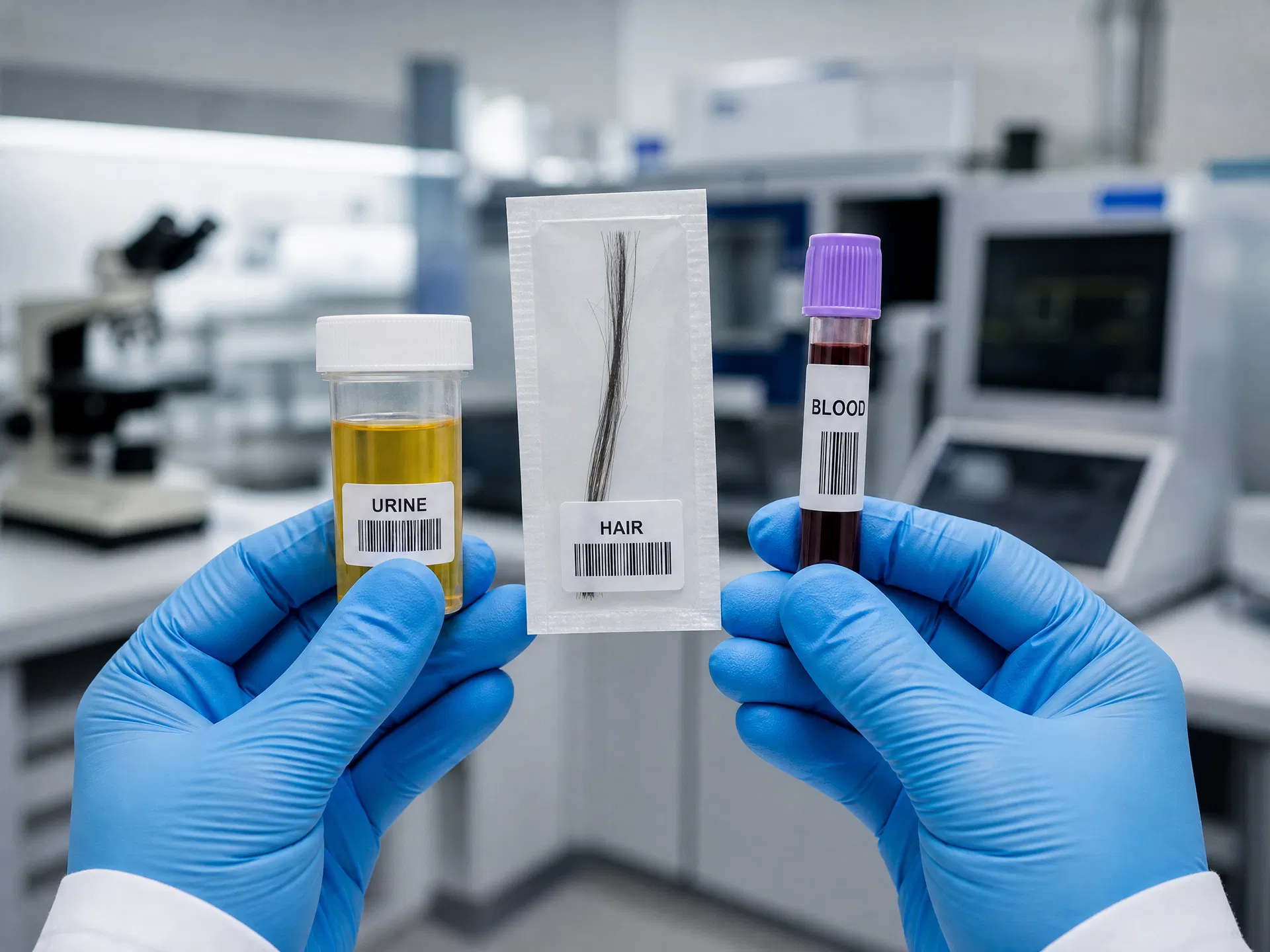
Drug and alcohol testing in legal proceedings refers to the scientific analysis of biological samples — urine, hair, blood, oral fluid, or breath — to detect the presence, concentration, or historical pattern of drug or alcohol use. In England and Wales, such testing is used across criminal defence, family court, immigration, and employment proceedings to provide objective, evidence-based information to the court.
Unlike clinical drug testing (which may use rapid immunoassay strips), forensic drug testing for legal proceedings must be conducted by an ISO 17025 accredited laboratory, follow validated analytical protocols (such as FSR-GUI-0029 or the SoHT 2023 consensus guidelines), and be interpreted by a qualified expert witness who can explain the results and their limitations to the court.
The choice of testing method depends on the specific question the court needs to answer: Was the individual under the influence of drugs at a specific time? Have they been using drugs habitually over the past three months? Are they complying with an alcohol abstinence order? Each question requires a different sample type, analytical method, and interpretive framework. Our panel of drug and alcohol expert witnesses can advise on the most appropriate testing strategy for your case.
The Six Testing Methods Used in Legal Proceedings
Select a sample type to view detection windows, analytical methods, accreditation standards, and legal context.
Urine Drug Testing
Most common method for recent drug use detection
Urine is the most widely used biological matrix for drug testing in legal proceedings. It is non-invasive, easy to collect, and provides a detection window of 1–7 days for most substances. Urine testing typically involves an initial immunoassay screen followed by confirmatory LC-MS/MS or GC-MS analysis for any positive results.
Detection Window Comparison Table
Approximate detection windows vary by individual metabolism, dose, and frequency of use. These figures are indicative; a qualified expert witness should be instructed to interpret specific results.
| Substance | Urine | Hair Strand | Blood | Oral Fluid |
|---|---|---|---|---|
| Alcohol (ethanol) | 12–24 hrs | Months (EtG) | 6–12 hrs | 6–12 hrs |
| Cannabis (THC-COOH) | 1–30 days* | Months | Hours (THC) | Hours–2 days |
| Cocaine (BE) | 2–4 days | Months | Hours | 1–2 days |
| Heroin (6-MAM) | 1–2 days | Months | Hours | Hours |
| MDMA (Ecstasy) | 2–4 days | Months | 1–2 days | 1–2 days |
| Benzodiazepines | 2–14 days† | Months | Days | Hours–days |
| Methadone | 3–7 days | Months | 1–3 days | 1–2 days |
| Ketamine | 2–4 days | Months | Hours | Hours |
* Cannabis detection in urine: single use 1–3 days; heavy daily use up to 30+ days. † Benzodiazepines: short-acting 2–3 days; long-acting (diazepam) up to 14 days.
Analytical Standards and Accreditation Requirements
For drug and alcohol test results to be admissible as evidence in legal proceedings in England and Wales, the laboratory must hold ISO 17025 accreditation from the United Kingdom Accreditation Service (UKAS). ISO 17025 is the international standard for testing and calibration laboratories and covers technical competence, management systems, and the validity of results.
The FSR's guidance on toxicology analysis for drugs sets out the minimum analytical requirements for forensic drug testing in criminal proceedings, including screening, confirmation, and reporting standards.
The internationally recognised consensus on hair testing cut-off concentrations and analytical requirements. Published in Drug Testing and Analysis (DOI: 10.1002/dta.3526). Mandatory reference for hair strand testing in legal proceedings.
Laboratory guidelines for forensic toxicology practice in the UK and Ireland (DOI: 10.1016/j.scijus.2010.09.004). Sets out quality assurance, chain of custody, and reporting requirements.
International consensus on EtG and EtS cut-off values in urine for alcohol abstinence monitoring (DOI: 10.1111/acer.12810). Widely applied in family court proceedings to interpret EtG results.
Drug test results from non-accredited laboratories, or results that have not been confirmed by LC-MS/MS or GC-MS, should not be relied upon as evidence in legal proceedings. Always request the laboratory's UKAS accreditation certificate and the full analytical report before serving results on the court.
How to Challenge Drug and Alcohol Test Results
Drug and alcohol test results are not infallible. A qualified drug and alcohol expert witness can review the laboratory report and identify grounds for challenge. Common grounds include:
Any break in the documented chain of custody — from sample collection to laboratory receipt — can render results inadmissible. The collector must verify identity, witness provision, seal and label the sample, and complete a chain of custody form.
Results from non-ISO 17025 accredited laboratories, or results outside the laboratory's scope of accreditation, may be challenged. Always request the UKAS accreditation certificate and verify the specific analytes are within scope.
An immunoassay screening result alone is insufficient for legal proceedings. A positive screen must be confirmed by LC-MS/MS or GC-MS before it can be relied upon as evidence. Failure to confirm is a significant analytical weakness.
For hair strand testing, the SoHT 2023 consensus sets specific cut-off concentrations for each drug class. Results reported below the SoHT cut-offs, or using non-standard cut-offs, may be unreliable and open to challenge.
Hair strand results can be affected by external contamination — for example, passive cannabis exposure in a household where cannabis is smoked. An expert can assess whether the concentration and metabolite profile is consistent with use or external contamination.
Bleaching, dyeing, perming, and other chemical treatments can degrade drug concentrations in hair, potentially producing false negatives or artificially low results. The expert must consider the hair treatment history when interpreting results.
Drug Testing in Drug-Driving Proceedings
Section 5A of the Road Traffic Act 1988 creates an offence of driving, attempting to drive, or being in charge of a vehicle with a specified controlled drug above a prescribed blood limit. The 16 specified drugs include both illegal substances (cannabis, cocaine, heroin) and prescribed medications (diazepam, morphine, clonazepam).
The prosecution process involves: a roadside oral fluid screen (DrugWipe); arrest and blood sample at the police station; laboratory analysis by LC-MS/MS; and comparison against the prescribed blood limits. A drug-driving defence expert witness can review the entire analytical process and identify any grounds for challenge.
Full prescribed limits: SI 2014/2868. See also our drug-driving defence guide.
Drug and Alcohol Testing in Family Court Proceedings
In Children Act 1989 proceedings, drug and alcohol testing is frequently ordered by the court to assess a parent's substance use and its impact on their ability to provide safe care. The most common testing methods in family proceedings are hair strand testing (for historical patterns) and EtG/EtS urine or hair testing (for alcohol abstinence monitoring).
Testing in family proceedings must comply with FPR Part 25 requirements. The expert must be jointly instructed by all parties, and the letter of instruction must be approved by the court. LAA prior authority is required for testing costs in legally aided cases — see our guide to LAA prior authority for expert witnesses.
Maps drug use patterns over 3–12 months. Segmental analysis can identify periods of increased or decreased use.
Learn moreDetects alcohol use within 80 hours. Used for short-term abstinence monitoring between court hearings.
Learn moreAssesses chronic excessive alcohol consumption over months. Cut-off: >30 pg/mg (SoHT 2023).
Learn morePhosphatidylethanol (PEth) is a highly specific alcohol biomarker detectable in blood for 2–4 weeks.
Learn moreHow to Instruct a Drug & Alcohol Testing Expert Witness
A step-by-step guide for solicitors and barristers instructing a drug and alcohol expert witness.
Determine which sample type is appropriate for the proceedings: urine for recent use, hair strand for historical patterns, blood for drug-driving, or EtG for alcohol abstinence monitoring. The proceedings type and the specific question to be answered will determine the appropriate method.
For legally aided cases, obtain LAA prior authority before commissioning testing. Drug and alcohol testing costs are not automatically covered by the legal aid certificate. Submit Form CW2 with a clear justification of why testing is necessary and proportionate to the proceedings.
Prepare a letter of instruction that sets out the factual background, the specific questions the expert is asked to address, the sample collection arrangements, and the required format of the report. The letter must comply with CrimPR Rule 19 (criminal) or FPR Part 25 (family) requirements.
Ensure sample collection is conducted by a qualified collector with a documented chain of custody. The collector must verify the donor's identity, witness the sample provision, seal and label the sample in the donor's presence, and complete a chain of custody form. Any break in the chain of custody can render results inadmissible.
Review the expert report for compliance with CrimPR Rule 19 or FPR Part 25 requirements before serving. The report must include the expert's qualifications, methodology, analytical results, interpretation, limitations, and a signed declaration of compliance with their duty to the court.
Frequently Asked Questions
Related Guides & Services
SoHT guidelines, segmental analysis, and how to challenge results in family court.
Read guidePost-mortem toxicology, ISO 17025 methodology, and criminal proceedings.
Read guideSection 5A RTA 1988, prescribed limits, and the statutory defence.
Read guideOur panel of UKIAFT-registered drug and alcohol expert witnesses.
Read guideHow to obtain LAA prior authority for drug testing costs.
Read guideExpert witness services for criminal defence solicitors and barristers.
Read guide