What Is a Joint Expert Statement?
A joint expert statement (also called a statement of agreement and disagreement) is a document produced by two or more expert witnesses after a without-prejudice discussion directed by the court. It records the matters on which the experts agree, the matters on which they disagree, and the reasons for any disagreement. In criminal proceedings it is governed by CrimPR Rule 19.6; in family proceedings by FPR Part 25.16. The statement is admissible in evidence and is served on the court and all parties.
The purpose of a joint expert statement is not to resolve the dispute between the parties — that remains for the court. Its purpose is to narrow the issues in dispute by identifying where the experts genuinely agree and where they genuinely disagree, so that the court's time at trial is focused on the real points of contention rather than matters that are not truly in issue. A well-drafted joint statement is one of the most effective tools for efficient case management in expert-heavy proceedings.
The without-prejudice nature of the discussion is critical to this process: it allows experts to speak frankly, to test each other's reasoning, and to narrow their differences without fear that their words will be used against the instructing party at trial. The joint statement itself, however, is not without prejudice — it is a formal document that will be before the court and will form part of the evidence.
Procedural Rules: CrimPR 19.6 and FPR 25.16
Joint expert statements are governed by different procedural rules depending on the type of proceedings. In criminal proceedings, the relevant rule is CrimPR Rule 19.6; in family proceedings, it is FPR Part 25.16. Both frameworks share the same core principles — the without-prejudice discussion, the prohibition on solicitor attendance, and the requirement to record both agreement and disagreement — but there are important procedural differences that practitioners must understand.
CrimPR 19.6 vs FPR 25.16 — Key Differences
The following table summarises the key differences between the joint expert statement procedures in criminal and family proceedings. Practitioners instructing experts in both types of proceedings should be aware of these distinctions, particularly the different practice directions and the different typical triggers for a joint meeting direction.
| Aspect | Criminal Proceedings | Family Proceedings |
|---|---|---|
| Governing Rule | CrimPR Rule 19.6 | FPR Part 25.16 |
| Proceedings | Crown Court & Magistrates' Court | Family Court & Family Division |
| Direction Required | Court direction required | Court direction required |
| Solicitor Attendance | Prohibited | Prohibited |
| Without-Prejudice | Discussion only; statement admissible | Discussion only; statement admissible |
| Practice Direction | CrimPR Part 19 Practice Direction | PD 25E |
| Typical Trigger | Conflicting psychiatric / forensic reports | Conflicting parenting capacity or hair strand reports |
| Deadline | Set by court direction | Set by court direction (often pre-IRH) |
Preparing the Experts' Meeting Agenda
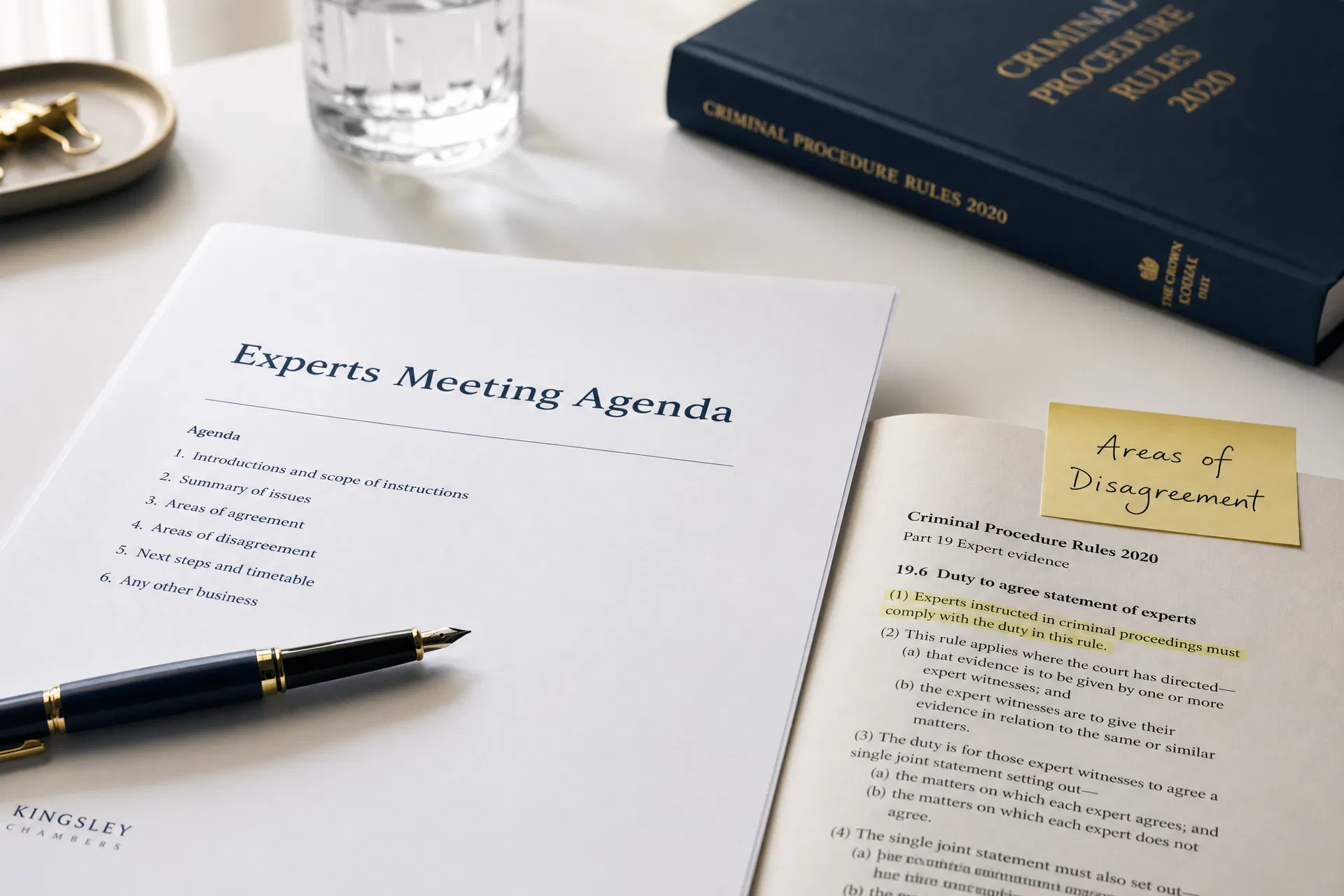
The written agenda is the solicitor's primary tool for ensuring that the experts' meeting addresses the issues the court needs resolved. A well-prepared agenda focuses the experts on the specific questions in dispute, avoids tangential discussion, and helps ensure that the joint statement is structured in a way that is useful to the court.
The agenda should be agreed between the instructing solicitors on both sides where possible, and should be served on the experts in advance of the meeting. It should be structured around the specific questions the court needs answered — not the parties' tactical positions. Agenda items that are framed in a way that pre-determines the answer, or that steer the expert toward a particular position, are improper and may be challenged.
In family proceedings, Practice Direction 25E provides detailed guidance on the preparation of the agenda and the conduct of experts' discussions. Solicitors instructing experts in family proceedings should read PD 25E carefully before preparing the agenda. In criminal proceedings, there is no equivalent practice direction, but the principles are the same: the agenda should be neutral, focused, and agreed where possible.
What We See When Joint Meetings Go Wrong
The most common failure mode we encounter is not an expert who refuses to agree — it is an expert who agrees to more than they should because they feel social pressure from a more assertive opposing expert. In our experience managing joint expert meetings across criminal and family proceedings, the most effective preparation is not coaching the expert on what to say, but ensuring they understand that a well-reasoned disagreement is a legitimate and often necessary outcome. An expert who records a genuine disagreement clearly and with reasons is doing their job correctly. An expert who minimises disagreement to avoid conflict is failing the court.
We also regularly see joint statements that record disagreement without reasons — the experts simply note that they disagree on a point without explaining why. This is unhelpful to the court and will often attract judicial criticism. When we brief our experts before a joint meeting, we emphasise that the reasons for disagreement are as important as the disagreement itself, and that a joint statement that explains the competing reasoning is far more valuable than one that merely lists the points of contention.
How to Prepare for a Joint Expert Meeting
Obtain and review the court direction
Confirm the court's direction for a joint expert meeting, including the deadline for the joint statement and the specific issues the experts are required to address. Check whether the direction specifies a particular format or requires the agenda to be agreed between solicitors.
Serve the opposing expert's report on your expert
Ensure your expert has received the opposing expert's full report, any supplementary materials, and the relevant factual evidence. Your expert cannot engage meaningfully in the joint meeting without a thorough understanding of the opposing position.
Prepare and agree the written agenda
Prepare a written agenda of the issues to be addressed, agreed with the opposing solicitor where possible. Structure the agenda around the specific questions the court needs answered. Do not frame agenda items in a way that pre-determines the answer or steers the expert toward a particular position.
Brief the expert on process and boundaries
Remind the expert of their overriding duty to the court, the without-prejudice nature of the discussion, and the prohibition on solicitor attendance. Make clear that the joint statement must honestly record both agreement and disagreement, and that any attempt to minimise disagreement artificially will be scrutinised by the court.
Review, sign, and serve the joint statement
Review the joint statement for completeness and compliance with the court's direction. Ensure it is signed by both experts. Serve it on the court and all parties within the directed timetable. If your expert has changed their opinion as a result of the meeting, notify the court and all parties immediately under Rule 19.2(6) or FPR Part 25.3.
Related Subtopics
Frequently Asked Questions
Related Guides
References
CrimPR Rule 19.6 — Joint expert statements in criminal proceedings (SI 2020/759)
FPR Part 25.16 — Experts' discussions in family proceedings (SI 2010/2955)
Practice Direction 25E — Guidance on experts' discussions in family proceedings
The Ikarian Reefer [1993] 2 Lloyd's Rep 68 — Cresswell J's seven duties of an expert witness
Phillips v Symes [2004] EWHC 2330 (Ch) — Personal costs order against expert for breach of duty
R v Dlugosz [2013] EWCA Crim 2 — Admissibility of expert evidence in criminal proceedings
Forensic Science Regulator — FSR-GUI-0029: Guidance on expert witness obligations
Expert Witness Institute — Code of Guidance on Expert Evidence
Law Society — Guidance on instructing experts in family proceedings