
What Is the Istanbul Protocol?
The Istanbul Protocol is the United Nations' definitive standard for documenting evidence of torture — formally the Manual on the Effective Investigation and Documentation of Torture and Other Cruel, Inhuman or Degrading Treatment or Punishment. First published in 1999 and substantially updated in 2022, it provides clinicians with a structured methodology for assessing and recording the physical and psychological sequelae of torture. In UK asylum proceedings, a report prepared in accordance with the Istanbul Protocol is the recognised standard for medical evidence of past torture or serious ill-treatment.
The Home Office, the First-tier Tribunal (Immigration and Asylum Chamber), and the Upper Tribunal all accept Istanbul Protocol reports as a distinct category of expert evidence — one that carries particular weight in credibility assessments. The 2022 revision strengthened the protocol's guidance on psychological assessment, gender-sensitive examination, and the documentation of sexual violence. Experts instructed in asylum proceedings should be working to the 2022 edition.
Unlike a standard psychiatric or psychological report, which focuses on diagnosis and treatment, an Istanbul Protocol report applies the protocol's graded consistency framework to assess whether physical scars, psychological symptoms, and behavioural presentation are consistent with the claimed history of torture. This structured analytical approach is what distinguishes it from general medico-legal evidence and gives it its particular evidential weight in asylum proceedings.
Frequently Asked at This Stage
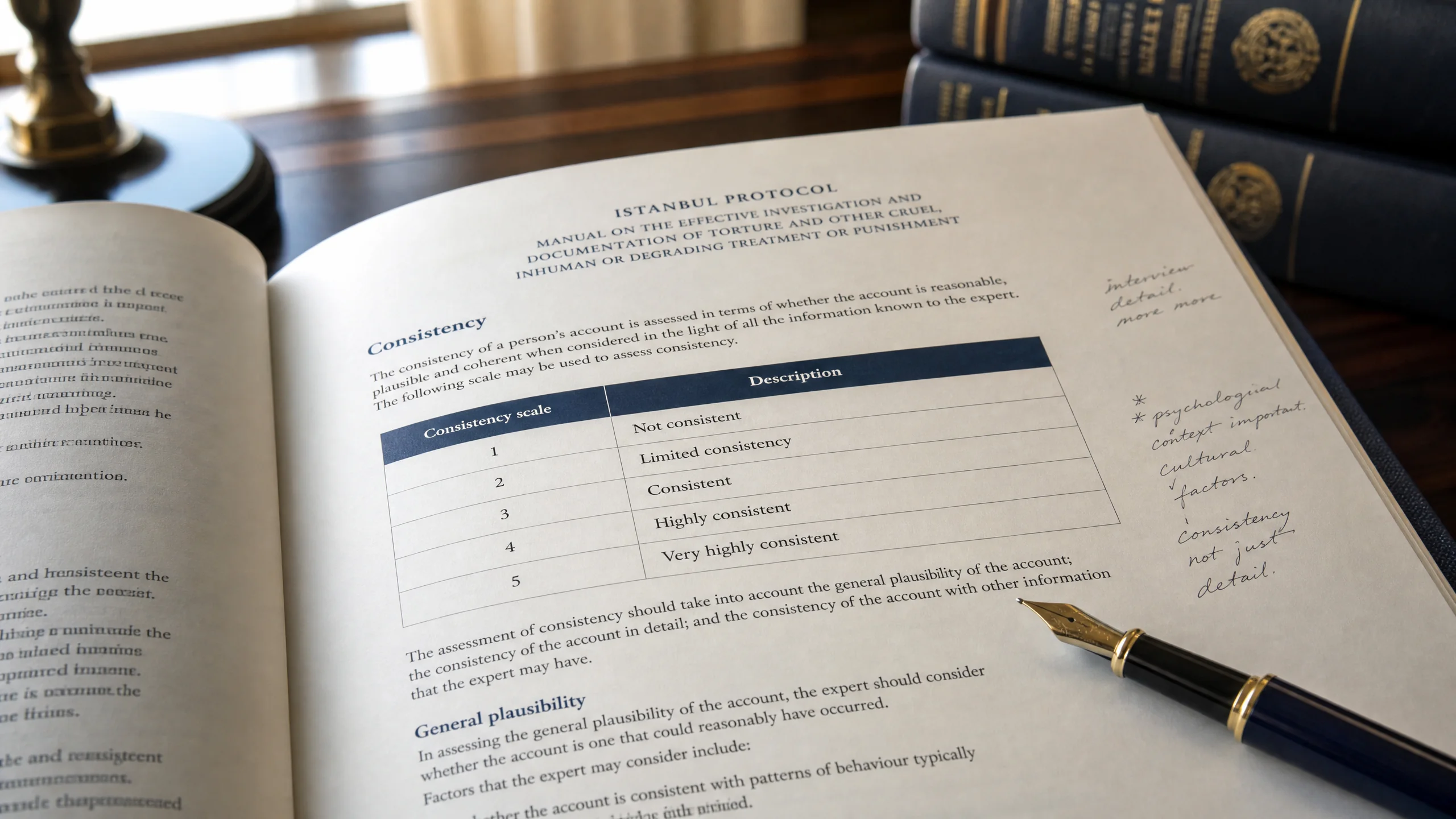
The Five-Point Consistency Scale
The Istanbul Protocol requires the examining clinician to apply a five-point graded scale to each physical and psychological finding. This scale is the analytical framework that distinguishes an Istanbul Protocol report from a standard medical report.
Mandatory Report Elements
A compliant Istanbul Protocol report must address all eight mandatory elements. Reports that omit any element risk being given reduced weight by the Tribunal.
Evidential Weight and Case Law
The courts and Tribunals have consistently affirmed the evidential significance of Istanbul Protocol reports in asylum proceedings. The key principle, established in SA (Somalia) v Secretary of State for the Home Department [2006] EWCA Civ 1302, is that a medical report consistent with the Istanbul Protocol should be given substantial weight when assessing credibility — even in the absence of other corroborating documentary evidence.
Psychological Assessment in Istanbul Protocol Reports
The 2022 revision of the Istanbul Protocol significantly expanded the guidance on psychological assessment. A compliant psychological evaluation must use validated instruments and address the full range of psychological sequelae associated with torture, including PTSD, depression, anxiety disorders, and somatic symptoms.
The expert must apply the five-point consistency scale to each psychological finding, considering whether the pattern of symptoms is consistent with the claimed history of torture. The 2022 Protocol also requires the expert to consider the impact of post-migration stressors — including detention, destitution, and separation from family — which can independently cause or exacerbate psychological symptoms. For a detailed guide to PTSD assessment in legal proceedings, see our article on PTSD in Legal Proceedings.
Legal Aid Funding for Istanbul Protocol Reports
Istanbul Protocol reports are routinely funded under Legal Aid Agency (LAA) immigration legal aid certificates. Prior authority from the LAA is required before instructing the expert. The prior authority application should include the expert's CV, a fee estimate, and a clear explanation of why the report is necessary for the proceedings.
For detailed guidance on LAA funding for expert witnesses, see our guide on Legal Aid and Expert Witnesses.
Navigating the 2022 Protocol Update in Tribunal Proceedings
Since the 2022 revision of the Istanbul Protocol, we have seen an increase in Home Office challenges to reports prepared to the 2004 edition. Instructing solicitors should confirm that their expert is working to the 2022 edition — particularly in cases involving sexual violence, where the updated guidance on gender-sensitive examination is now expected by the Tribunal.
We have also seen cases where the Tribunal has given reduced weight to reports that apply the consistency scale to the overall clinical picture rather than to each individual finding. The 2022 Protocol is explicit: the scale must be applied finding by finding, with separate reasoning for each. Experts who apply a single overall rating risk having their evidence challenged on this basis.
How to Instruct an Istanbul Protocol Expert
A five-step process for instructing a qualified expert and obtaining a compliant medico-legal report.
An Istanbul Protocol report is required when your client alleges torture, serious ill-treatment, or sexual violence and the medical evidence is central to the credibility assessment. Consider instructing early — reports take four to eight weeks and delays can affect appeal timetables.
Related Subtopics
Key concepts connected to Istanbul Protocol expert assessments in UK legal proceedings.
A clinical report prepared by a qualified expert for use as evidence in legal proceedings, addressing the medical aspects of a case within the expert's area of specialism.
The Istanbul Protocol's graded framework for assessing whether physical and psychological findings are consistent with a claimed history of torture, ranging from 'not consistent with' to 'diagnostic of'.
A structured clinical evaluation of post-traumatic stress disorder using validated instruments such as the CAPS-5, PCL-5, or IES-R, commonly required in both asylum and criminal proceedings.
The specialist tribunal that hears asylum and immigration appeals in England and Wales, including cases where Istanbul Protocol reports are submitted as expert evidence.
The process by which the Tribunal evaluates the truthfulness of an asylum seeker's account, in which an Istanbul Protocol report can provide corroborating medical evidence.
The systematic clinical recording of physical and psychological evidence of torture in accordance with international standards, as set out in the Istanbul Protocol.
Advance approval from the Legal Aid Agency for expenditure on expert evidence, required before instructing an Istanbul Protocol expert under a legal aid certificate.
The Ikarian Reefer principle that an expert's overriding duty is to the court, not the instructing party — applicable to Istanbul Protocol experts giving evidence at the Tribunal.
Frequently Asked Questions
References & Further Reading
- SA (Somalia) v SSHD [2006] EWCA Civ 1302 — substantial weight to Istanbul Protocol reports in credibility assessments.
- KV (Sri Lanka) v SSHD [2019] UKSC 10 — expert opinion on scarring causation admissible under Istanbul Protocol methodology.
- Patel, N. et al. (2022). Documenting torture and ill-treatment: the Istanbul Protocol in practice. BMJ, 376, e068604.
- Physicians for Human Rights (2020). Asylum Seeker and Refugee Health: A Handbook for Health Professionals. PHR.
Quick Reference
Instruct an Istanbul Protocol Expert
We can identify a qualified expert working to the 2022 Protocol within 24 hours.
Instruct an ExpertHow It WorksRelated Articles
Confirm that your expert is working to the 2022 edition. Reports prepared to the 2004 edition may be challenged by the Home Office in current proceedings.
Related Guides
PTSD in Legal Proceedings
ICD-11 criteria, Istanbul Protocol methodology, and how PTSD evidence is used across jurisdictions.
Vulnerability Assessment in Immigration Proceedings
Rule 35, the Adults at Risk policy, and how vulnerability evidence is used in detention reviews.
Modern Slavery & Trafficking Expert Evidence
NRM referrals, conclusive grounds decisions, and the expert's role in trafficking proceedings.
Age Assessment in Immigration Proceedings
Merton-compliant age assessments, the role of the expert, and challenging local authority decisions.
Psychology Expert Witnesses
Our panel of forensic and clinical psychologists for asylum and immigration proceedings.
Immigration & Asylum Expert Witnesses
Our full panel of experts for immigration tribunal and asylum proceedings.